
Welcome to the general rules for analysis A Pokémon card! The method is detailed in 6 points, allowing you to get a precise idea of the value of your Pokémon cards. Let's go! (*^-^*)
Rule #1: Identify its rarity
The basic rule is to know what type of card we're dealing with. We will therefore detail the different types of rarity here, from the most general to the most specific.
Common card, uncommon & rare
Three types of "basic" cards can be quickly identified by a symbol in the bottom corner of the card:
A circle = common card
A diamond shape = an uncommon card
One star = rare card.

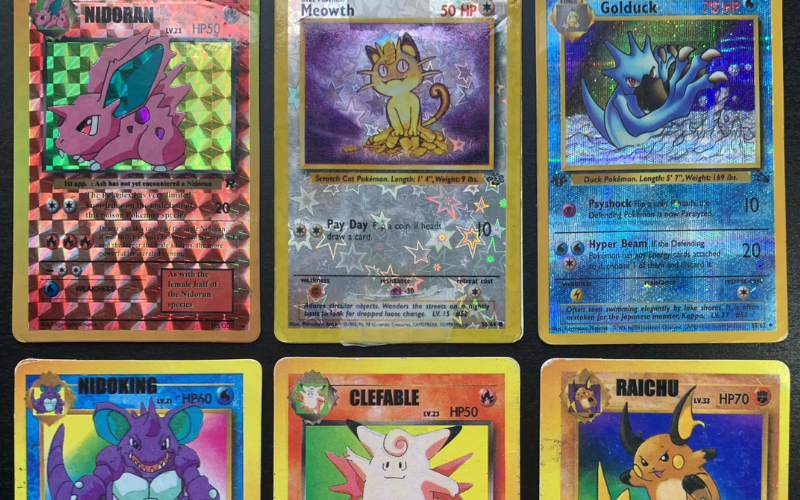
Reverse or holographic card?
There are two types of shine:
– Reverse : the entire card shines except for the illustration
– Holographic : the illustration shines

Ultra rare card
Ultra rare cards are recognizable by their bright white star!

Secret map?
If your card number is higher than the number of cards in the set (like here, 245/236), then your card is secret .

Full Art Card
A card is considered full art when the illustration extends beyond its edges.

Rainbow Map
A rainbow card uses the same illustration as a full-art card but is distinguished by its rainbow colors. Rainbow cards are always secret cards.

Gold Card
Gold cards are much rarer and are recognizable by their gold color. These cards are also secret cards.

Map of Alternatives
Alternative cards are derived from their Full Art version (same attacks, same HP). Their style is much more elaborate, making them particularly sought after by collectors. They are also secret cards.


We then distinguish numerous variations of ultra-rare cards, evolving throughout the series. Here are a few examples :
Gold Star

Level X

Prime

Legend

Turbo

Squad

Rule #2: Identify the series and the extension
The second thing that will determine the value of your card is the expansion it comes from. There are many different expansions, and generally speaking, the older they are, the higher their value will be. Here's how to tell them apart!
Identify the year of printing and/or the extension logo
The year ( here, in red ) and the logo ( in blue ) are usually found at the bottom of the card (or under the illustration, for older cards).
The older a card is, the higher its value .
In addition, some expansions are more popular than others, which can also increase the price of cards (even common ones!).

Even with "equal weapons," a card will not have the same value at all. For example, here the three cards are common and represent Vulpix . However, 15 years separate these cards.
Here is their approximate rating:
Ex Forgotten Legends: ~ €2 to €3
The Call of Legends: ~ €1
Sword & Shield: ~€0.05
Promotional cards
There are a huge number of promotional cards ( also called black star , because of the logo ), released on special occasions, in special boxes , etc.
Generally speaking, it is not the cards that are worth the most, since they are not obtained by chance.
However, depending on the Pokémon depicted or its limited release , its value can quickly increase.

Rule #3: What is the condition of your card?
Collectors love cards in perfect condition . If your card is badly damaged, or even bent, it loses all its value! Here are the criteria I consider fair, but everyone is free to be more or less strict.
Of course, the more damaged your card is, the lower its value will be.
Mint (M)

The card is like new , with no white spots visible on the back.
Near Mint / Excellent (NM/EXC)

The card is in perfect condition on the front , but has one or two small white spots on the back.
Good

The card has some scratches on the front and visible white spots on the back, but no creases .
Light Played (LP)

The card is whitened on the back edges and shows some black dots on the front edges, but without any creases .
Played / Poor

In addition to the various defects mentioned above, the card is bent in places.
Rule #4: The popularity of the Pokémon
The Pokémon's popularity within the community is one of the final factors that can increase the value of your card. Indeed, you may have already heard of certain Charizard cards often reaching exorbitant prices. But it's not the only one that finds buyers, and other Pokémon like starters , Eeveetions , or even Pikachu , for example, are all factors that will add value to a card.
If we compare our Vulpix cards presented in Rule #2 with a Pikachu card, you will quickly realize the impact of a Pokémon's popularity.
(I specify that the cards compared of Vulpix & Pikachu are all common , French , in perfect condition , not shiny and from close expansions ).


Ex Emeraude: ~ €20
Supreme Winners: ~€7
Harmony of Minds: ~ €4
Rule #5: The language
It may seem strange, but cards don't necessarily have the same ratings in French , English, or Japanese . This is due to different printing quotas, which directly influence supply and demand , as well as individual preferences.

Rule #6: Where to find prices?
You now know the main rules for analyzing your card and allowing you to determine, according to each criterion, a first idea of its value.
On the other hand, it's useful to find price sources online, and we'll use two websites that, in my opinion, accurately reflect the reality of the card market. For this example, we'll search for a French promotional card: Amphinobi EX [Promo SVP 132].
1) eBay

The first is world-renowned because it is… eBay ! Offering auctions in addition to immediate sales , it makes it easy to see how much a buyer is willing to pay for a card.
Type in the card you're looking for and select the "successful sales" filters. This will only show you cards that have been sold! <(^.^)>
We note here that recently , the latest sales have been around €19 !
Try, as far as possible, to find as many sales as possible, check the condition of the cards sold, their language , etc. The more data you have, the more reliable the rating will be.
You can also exclude terms from the search by using the minus sign " - ", as here with " -PSA " and " -PCA ", in order not to see sales relating to graded cards.
2) Cardmarket

The Cardmarket platform is also very popular and a great search tool! Don't forget to select your preferred language (in this case, "French") and compare your card's condition with the seller's!
For rarer or older cards, remember to compare the prices you find with those on eBay. Just because a card has a price "x" doesn't mean it will sell; the fewer offers there are, the less effective Cardmarket will be, although it can give you a general idea.
Finally, be careful with the curves and trends announced above: they take into account all languages and all conditions without distinction , which often results in a distorted average price.
We've finished with the basic rules. To delve deeper and expand on this analysis, you'll find plenty of other topics on our blog, so feel free to take a look! (≧∇≦)/

Leave a comment